
Call it a crystal-like object until the game names it
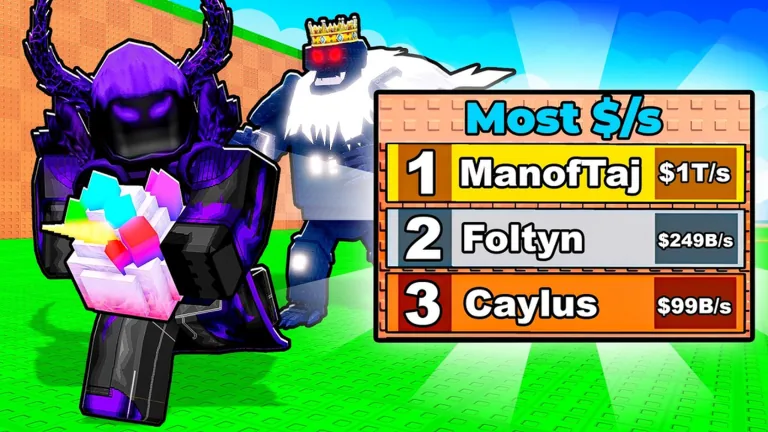
The official cover gives INFs ADMINS in SAE carrying objects one clear visual: a dark, horned avatar holds a bright cluster of faceted pieces beside the Most $/s leaderboard. Describe it as a crystal-like gameplay object until the live interface provides an exact name.
Do not rename it an egg, pet, mutation, producer, or stolen item. The cover does not show how it was obtained, where it goes, whether it changes movement, or whether it earns money. Those rules need direct checks inside this exact experience.
Status checked September 14, 2026. The object is visible in the official promotional image; pickup, drop, theft, inventory, base, hatch, and income behavior are not publicly documented.
Use the pickup, move, release loop
When you find a matching object in the live game, test it through one short loop:
- Inspect: record its displayed name, prompt text, location, and nearby markers.
- Pick up: use the exact prompt and note whether it enters the avatar’s hands, an inventory slot, or another interface area.
- Move: walk a fixed route and compare normal movement with carrying movement.
- Release: use only a visible drop, place, sell, or cancel action.
- Check the result: record the destination, any message, cash,
$ / s, and whether the object remains available.
Do not test several destinations on the same valuable object. First use a common or replaceable object if the game identifies rarity or value.
| Stage | Record | Avoid assuming |
|---|---|---|
| Before pickup | Name, prompt, location, cash, $ / s | That the object is free or unowned |
| While carried | Movement, jump, visible slot, warnings | That every object uses the same rules |
| On release | Exact action and destination | That drop and place have the same result |
| After release | Object state, cash, rate, message | That a visual disappearance means a sale |
| After rejoin | Object and progress state | That session behavior always persists |
Identify the interaction without guessing
The prompt is the most useful label. Capture its exact verb: pickup, take, carry, place, deliver, sell, or another term. Different verbs can lead to different outcomes.
If no prompt appears, check distance and camera angle before deciding the object is decorative. If another player is nearby, wait for a quieter test so you can separate your action from theirs. Roblox lists a server size of seven, but the public listing does not describe player ownership, stealing, trading, or protection rules.
Use three identity checks:
- Match the object’s live shape and colors to the cover without assuming they are identical.
- Record the exact live name wherever the interface displays it.
- Keep the generic “crystal-like object” label if no name is shown.
That simple naming habit keeps a later guide from building an entire progression route around the wrong item type.
Measure movement and drop behavior
To test a carrying penalty, walk the same short path before and after pickup. Use fixed landmarks rather than estimating by feel. Record whether sprint, jump, camera movement, or interaction prompts change.
Then test only the normal release control shown by the game. Do not reset the avatar to force a drop. A normal release answers the basic interaction question without risking progress.
Check these outcomes separately:
- Does the object land in the world or snap to a marked position?
- Can the same player pick it up again?
- Can another player interact with it?
- Does it return to its original location after a timer?
- Does leaving the area cancel the carry state?
- Does the interface warn about a protected or invalid zone?
Record what happens once. Do not describe player theft or safe-zone protection until the live game demonstrates it.
Test death and rejoin without risking a valuable object
Death behavior and save behavior are different questions. Use a low-value object only after the game identifies one, and avoid any reset option that warns about data loss.
For a normal death check, record the object’s state before death, where it is afterward, and whether cash or $ / s changes. For a rejoin check, release or secure the object through a normal interface action first. Record the state, leave normally, and compare after joining again.
One successful return does not establish every object’s persistence. Different object types, slots, or destinations can follow different rules. Keep each result tied to the exact live name you tested.
Check whether carrying affects the economy
The cover places the carried cluster near the Most $/s board, but composition alone does not prove an income connection. Use a controlled rate check:
- Record
$ / sbefore pickup. - Pick up the object and wait through two visible cash updates.
- Record
$ / swhile carrying. - Release it through the normal action.
- Record the rate again.
If the rate changes, repeat once with the same object type and action. If only cash changes, record it as a one-time economy result. If nothing changes, the object can still serve another purpose; do not force an income explanation.
Mistakes that create false mechanics
The broader SAE family is not an instruction manual for this game. Similar games can use eggs, pets, bases, and theft, but none of those names is confirmed here.
A bright object is not automatically currency. Wait for the live name and result message.
Save rare-looking objects for later. Learn release and persistence rules with something replaceable.
Resetting is a poor way to discover drop behavior. Use the normal control and avoid destructive tests.
Do not change cash and carrying state together. Record cash and $ / s before each single action.
FAQ
What is the object shown in the INFs ADMINS in SAE cover?
It is a bright, crystal-like cluster held by the foreground avatar. Its exact live name is not publicly documented.
Is the carried object an egg or pet?
That is not confirmed. Use the name shown in this experience rather than a label from another SAE game.
Does carrying an object slow the player?
No movement penalty is documented. Walk the same fixed route before and during a carry to test it.
Can another player steal a carried object?
Player theft is not confirmed. Test interaction only with consent and a replaceable object after the game exposes ownership rules.
Does the object increase money per second?
The cover does not establish that connection. Compare $ / s before pickup, while carrying, and after release.