
Read the suffix, then verify the full value
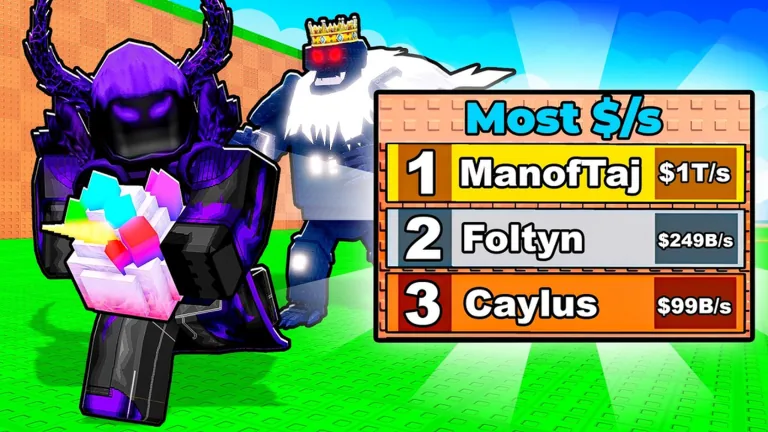
The official cover confirms that INFs ADMINS in SAE number abbreviations include large-value suffixes on the Most $/s board. It shows examples using B and T. That is enough to recognize a compact display, but not enough to publish a complete suffix ladder, exact conversion table, rounding rule, or maximum value.
Use the suffix as a quick size comparison. For exact decisions, open any live detail panel that exposes more digits and record the value before spending. If the game shows only the compact label, compare changes within the same suffix instead of guessing hidden digits.
Status checked September 14, 2026. The promotional cover includes
$99B/s,$249B/s, and$1T/sexamples. Treat them as display examples, not guaranteed milestones or current player records.
What B and T tell you, and what they do not
In common English number notation, B is used for billion and T for trillion. The cover places those letters after a dollar value and before /s, so the complete label is an abbreviated income rate.
The cover does not establish every rule around that notation:
- whether the game uses
KorMbelowB; - whether values use decimal places;
- whether the display rounds down, rounds normally, or truncates;
- what comes after
T; - whether cash and
$ / suse the same suffix sequence; - whether settings can switch to scientific notation.
Do not fill those gaps from another tycoon game. Add only the suffixes shown by the live interface.
Build a capture-first suffix table
The reliable method is reach, capture, compare, repeat:
- Reach a boundary: watch for the displayed value to approach the next visible suffix.
- Capture both views: record the compact label and any detailed stat card at the same moment.
- Compare around the change: save one value below the suffix transition and one above it.
- Repeat once: confirm the same transition with a second sample or later session.
Use a table like this while playing:
| Field | What to record |
|---|---|
| Display location | Cash counter, personal rate, leaderboard, or another panel |
| Compact value | The exact text, including decimals and /s |
| Detailed value | Every visible digit, if another panel provides it |
| Before transition | Last captured value using the previous suffix |
| After transition | First captured value using the new suffix |
| Rounding behavior | What changed in the detailed number when the label changed |
| Date and server | Enough context to detect later interface changes |
Once filled, the table gives you a notation guide tied to the live game. It also keeps a standard K/M/B/T chart from sneaking in as an untested answer.
Compare values without hidden-digit guesses
Suppose two players both display 1T/s. The board does not tell you whether their underlying rates are equal. One could be just over the threshold while another could be much higher but still rounded to the same visible label.
Use three comparison rules:
- A different leading number with the same suffix is a useful visible comparison.
- The same compact label is a displayed tie, not proof of exact equality.
- A larger suffix outranks a smaller one only after the live game confirms the order in its own notation.
The third rule matters once unfamiliar suffixes appear. Do not assume a letter means the same thing it means in another Roblox economy.
Separate money from money per second
The /s part changes the meaning. $249B describes an amount; $249B/s describes a rate. If the game shows both, capture them in separate columns.
| Display | Read it as | Best use |
|---|---|---|
$... | Current money balance | Checking affordability |
$.../s | Displayed income rate | Comparing production speed |
Most $/s | Ranking label for rates | Comparing leaderboard positions |
Do not multiply the compact rate by time until you have checked the payout timing. A displayed per-second rate can still reach the cash counter through animation or batched updates.
Mistakes that break abbreviation guides
A complete suffix list would be premature. Only B and T are visible in the accepted cover.
Promotional values are poor progression goals. The cover’s numbers demonstrate scale, not account requirements.
Decimals and rounding matter. A compact display can hide a meaningful gap between two upgrades.
Keep balance and rate captures separate. Always include /s when the value is a rate.
Leave notation from the broader SAE family out of the table. A similar name does not establish identical suffixes or formulas.
FAQ
Which number abbreviations are confirmed in INFs ADMINS in SAE?
The official cover visibly uses B and T in money-per-second examples.
Does the game use K and M?
That is not documented in the accepted public material. Record those suffixes only if the live interface displays them.
What comes after T?
The current public view does not answer that. Follow the live suffix order rather than importing a list from another game.
Is 1T/s an exact value?
It is a compact display. Check a detailed stat panel for hidden digits or decimals before treating two 1T/s rates as equal.
Are cover values real progression milestones?
No. They are promotional display examples and do not establish when a live player reaches each suffix.